
Key Takeaways
Supporting Black-owned businesses strengthens generational wealth and local communities. Black entrepreneurship began as survival and became strategy, ownership, and power. Black-owned businesses built jobs and institutions when systems shut us out. Redlining, segregation, and violence disrupted Black business ownership and wealth.
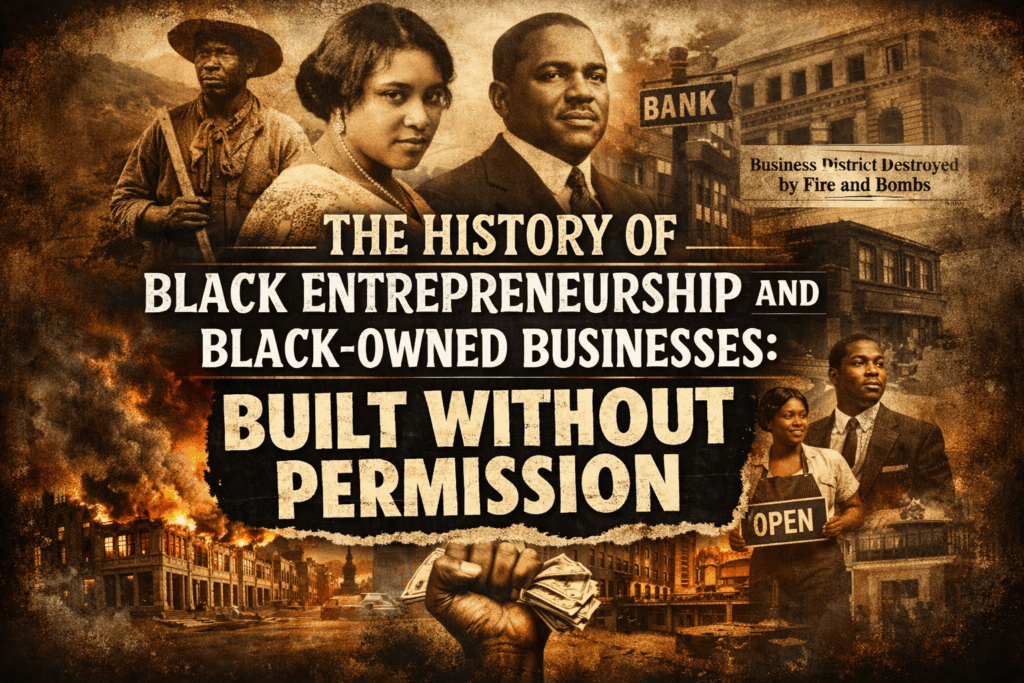
Black entrepreneurship didn’t start as a trendy hashtag or a “support small business” moment. The history of Black entrepreneurship began during slavery and continues into today, rooted first in survival, then sharpened into strategy, ownership, and self-determination. When opportunities were blocked, we created our own doors. When markets were rigged, we built our own systems. Instead of waiting for an invitation to the table, we built our own.
From the beginning, Black people have been inventors, traders, farmers, artisans, and builders, even while denied the legal rights that made Black business ownership “official.” Our skills, tenacity, and determination drove us to excel, and that excellence showed up in Black-owned businesses that fed families, created jobs, and anchored neighborhoods.
Black Entrepreneurship During Slavery and Reconstruction
Even under slavery, Black enterprise existed in limited and often dangerous forms. Skilled labor, gardening, crafts, and trade became ways to create value when freedom and wages were restricted. After emancipation, Black communities moved quickly to build institutions that would serve us when mainstream systems would not.
Businesses weren’t just about income. They were about dignity. They were about employing our people, financing our neighborhoods, and creating spaces where we could live and work without constant humiliation or danger. Black-owned barbershops, beauty salons, grocery stores, newspapers, insurance companies, banks, and pharmacies became cornerstones of community life and early examples of Black economic empowerment in action.
What Black Entrepreneurship Has Always Done
- Black business ownership has never been only about profit. It has always been tied to community stability and collective progress.
- Created economic stability when traditional employment was limited or exploitative
- Built community institutions like newspapers, schools, and mutual aid societies
- Protected cultural identity through products, services, and spaces made for us
- Generated jobs inside neighborhoods that were intentionally underinvested
The Rise of Black Business Districts and Black Wall Street
As the late 1800s turned into the early 1900s, Black-owned businesses expanded into organized Black business districts and national networks. People often point to Black Wall Street in Tulsa, but it wasn’t the only example. Across the country, Black communities built thriving commercial corridors supported by local loyalty, community networks, and Black newspapers.
The newspaper wasn’t just media. It was marketing, advocacy, and community memory all at once. It helped people find Black-owned businesses, kept money circulating in the community, and documented who was building what, where.
The Backlash: Systemic Barriers and Stolen Momentum
Then came the backlash. Racial terror, segregation laws, redlining, and violence were direct attacks on Black wealth-building. Entire business districts were destroyed, and progress was intentionally disrupted. These weren’t side effects of history. They were obstacles aimed at limiting Black business ownership, property, and long-term prosperity.
Barriers that shaped the journey
- Redlining and denied loans that limited growth and property ownership
- Segregation laws that restricted where and how businesses could operate
- Racial violence that targeted success and prosperity
- Unequal access to education and contracts that kept profits out of Black hands
The Civil Rights Era and the Economic Shift
The Civil Rights era opened doors, but it also introduced new complications. Integration expanded access to businesses and services outside of our communities, and that shift often pulled money out of Black business districts as more Blacks spent their dollars at white-owned businesses.
This matters because it shows a hard truth: progress can expand choices, but it can also weaken local ecosystems if community buying power stops being consistent.
Black Entrepreneurship Today: A New Chapter of Visibility and Power
Today, Black entrepreneurship is in a new chapter. Social media has changed how businesses are discovered. E-commerce has made it possible to sell beyond neighborhood borders. And technology, when used with intention, can help Black founders build visibility without waiting for permission.
But modern success still runs into familiar issues: access to capital, fair lending, sustainable mentorship, and systems that don’t require Black entrepreneurs to shrink who they are to be taken seriously. The goal is not just to start businesses. It’s to sustain them.
What we need now is consistent community buying power, not support that only shows up during a trend or a crisis. We also need a stronger business infrastructure, meaning solid websites, healthy email lists, smooth operations, and clean accounting. Just as important is real access to capital and mentorship that supports growth without demanding assimilation. And finally, we need visibility systems that make it easy for people to actually find, trust, and choose Black-owned businesses on a regular basis.
Final Takeaway: This Is Legacy Work
The history of Black entrepreneurship is the history of making something out of nothing, then making it again when “nothing” gets forced on us. It’s innovation under pressure. Legacy with receipts. And proof that we have never lacked talent, only access.
When we support Black-owned businesses, we’re not just making a purchase. We’re participating in a long tradition of building generational wealth, protecting our communities, and strengthening Black economic empowerment on purpose.